
Barcelona strengthens its role as a global reference in life sciences
Barcelona is consolidating itself as an international reference hub in life sciences, a strategic sector with a strong economic, scientific, and social impact. In this context, Barcelona Global has reinforced its commitment to talent, innovation, and international outreach with two key initiatives: the launch of the first Diploma in Healthcare Data Science, in collaboration with the University of Barcelona (UB), and the unveiling of the new Brain Center at Hospital del Mar, a pioneering unit dedicated to the comprehensive treatment of brain diseases.
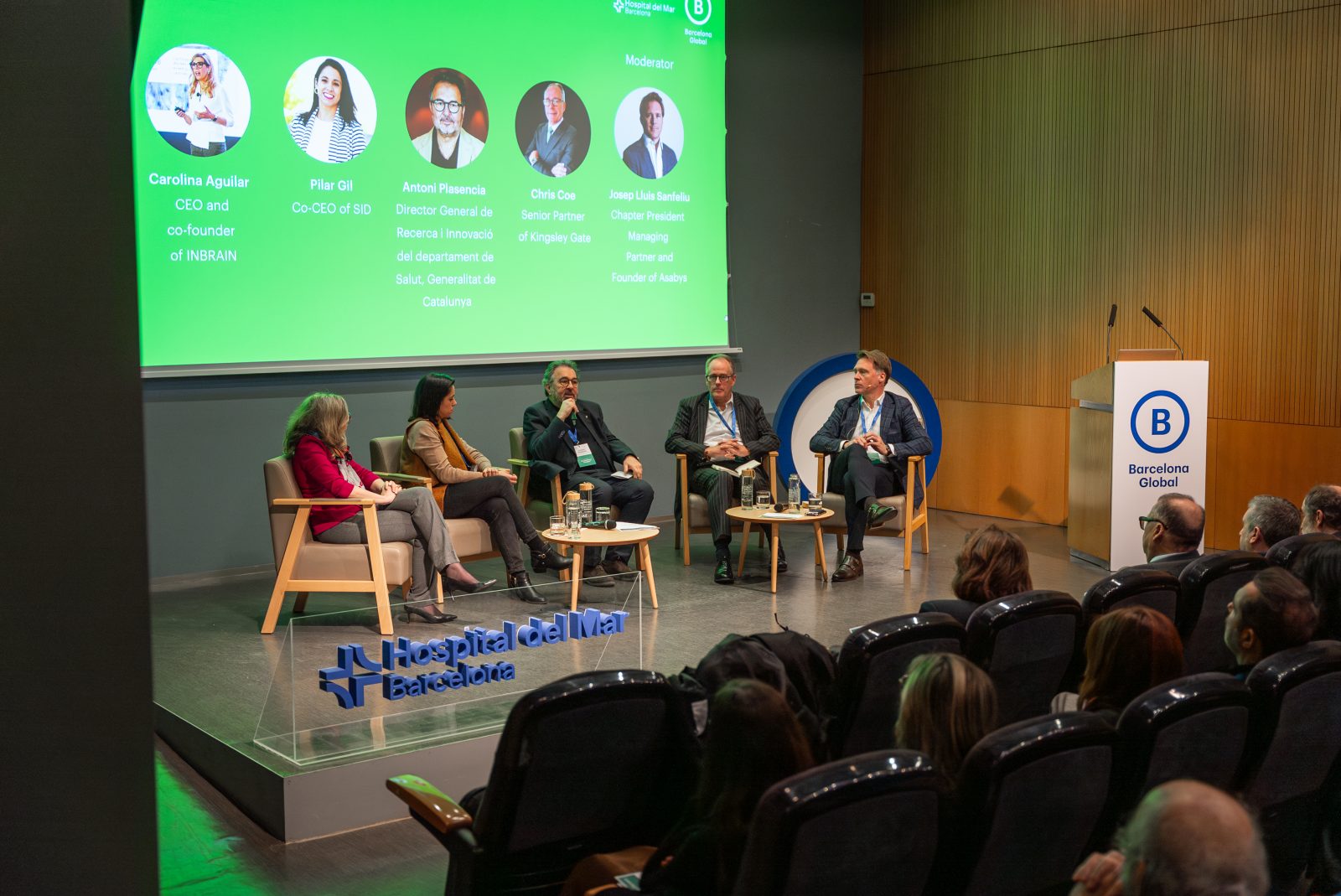
These initiatives were unveiled at the plenary meeting of Barcelona Global's Chapter of Life Sciences, held at the Hospital de la Mar auditorium. The event opened with a speech by Barcelona Global's president, Ramon Agenjo, who welcomed the attendees and introduced the various participants in the Chapter. In this context, the manager of Hospital de Mar, Jaume Raventós, thanked Barcelona Global for choosing this healthcare center to host the event, a choice that, he noted, reflects Hospital de Mar's clear commitment to life sciences and to research and innovation in health.
The meeting also featured prominent representatives from the ecosystem, such as Carolina Aguilar (INBRAIN), Pilar Gil (SID), Chris Coe (Kingsley Gate), Gonzalo de Miquel (Alexion, AstraZeneca Rare Disease) and concluded with a speech by Barcelona Global CEO, Mercé Conesa, who emphasized the importance of public-private collaboration and talent as pillars for the international positioning of Barcelona's biomedical ecosystem.
Talent and data, keys to the medicine of the future
Barcelona Global, together with the University of Barcelona, has launched the first Diploma in Healthcare Data Science, with the aim of strengthening specialized talent in the field of health and data analysis, and of positioning Barcelona's biomedical ecosystem as an international benchmark.
According to Pau Almuni, deputy director of the diploma and global director of Evinova, the program aims to strengthen Barcelona as the European capital of health sciences by training professionals specialized in data analysis applied to the clinical and healthcare setting. The diploma is supported by the AstraZeneca Global Hub and is based on collaboration between academia and the business sector, integrating local talent and international experience. The program has a total duration of 360 hours, of which 180 are instructional and 180 are for non-face-to-face work, and is aimed at graduates and professionals in health sciences, scientific and technological disciplines, and profiles with experience in the pharmaceutical, biotechnology, or biomedical industry.
In this regard, Antoni Plasencia, Director General of Research and Innovation at the Department of Health of the Generalitat of Catalonia, emphasized during his remarks the importance of uniting research, innovation, and the health system, highlighting the digitization efforts of the Catalan health system and the transformative impact of the new European regulations, which allow the use of data for research and innovation.
The Brain Center at Hospital del Mar, an international model of care
Another of the major innovations presented was the Brain Center at Hospital del Mar, an already operational unit that aims to improve the treatment of brain diseases, both psychiatric and neurodegenerative, through an integrated, patient-centered model.
The head of Neurology and director of the center's Neurosciences program, Pablo Villoslada, one of the driving forces behind the Brain Center alongside Carlo Marras, director of the Department of Neurosurgery, explained that it is an “integrated care process,” in which external organizations such as the Pasqual Maragall Foundation or Aspace also collaborate. According to Villoslada, this is an innovative model worldwide.
The Brain Center addresses conditions such as treatment-resistant depression, bipolar disorders, schizophrenia, Parkinson's disease, ALS, Alzheimer's disease, and epilepsy. “There are more than 500,000 patients who are not being treated satisfactorily,” Villoslada warned, highlighting the center's specialization in neuromodulation.
Carlo Marras emphasized that neurosurgery represents a great therapeutic opportunity, especially in fields such as epilepsy, where Hospital del Mar is a reference center. “Today we perform minimally invasive surgeries that were unthinkable in the past,” he said, also highlighting the potential of neuromodulation in psychiatric disorders, movement disorders, and pain.
Neuromodulation is, in fact, the Brain Center's major technological bet. Hospital del Mar collaborates with engineers from UPF and UPC in developing its own devices, as well as with international companies, with tangible results: a 30% improvement in the quality of life and brain or mental health of patients in its target population.
If you want to learn about the latest news on Barcelona, its talent, and its strategic projects, subscribe to the Barcelona Global Blog.